

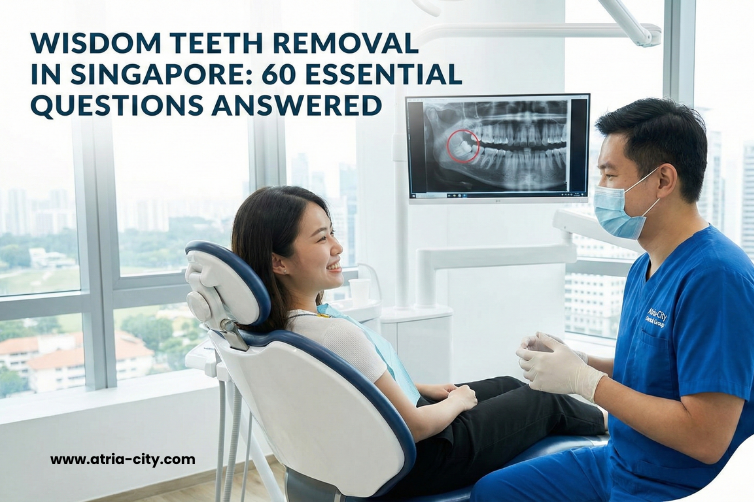
Wisdom teeth, or third molars, are the last teeth to emerge, typically appearing between ages 17 and 25. While some people have no issues with their wisdom teeth, many experience pain, infection, or crowding that necessitates removal. If you’re facing wisdom tooth extraction in Singapore, you likely have questions about the procedure, recovery, and costs.
At Atria-City Dental Group, our experienced oral surgeons perform wisdom tooth extractions with precision and care, ensuring patient comfort throughout the process. This comprehensive FAQ guide addresses the 60 most common questions about wisdom teeth removal.
Understanding Wisdom Teeth
1. What are wisdom teeth?
Wisdom teeth are the third and final set of molars located at the very back of your mouth, with two on top and two on the bottom.
2. Why are they called wisdom teeth?
They earned this name because they typically emerge during late adolescence or early adulthood, an age historically associated with increased maturity and wisdom.
3. At what age do wisdom teeth come in?
Most wisdom teeth erupt between ages 17 and 25, though timing varies. Some people’s wisdom teeth never emerge at all.
4. Does everyone have wisdom teeth?
No. Approximately 5-37% of people are missing one or more wisdom teeth due to evolutionary changes in jaw size and dental development.
5. Do wisdom teeth serve any purpose?
Evolutionarily, wisdom teeth helped our ancestors chew tough, raw foods. Today, with softer diets and utensils, they’re largely unnecessary and often problematic.
When Wisdom Teeth Need Removal
6. Do all wisdom teeth need to be removed?
No. If wisdom teeth erupt fully, are properly aligned, don’t cause pain or infection, and can be cleaned effectively, they may not require removal.
7. What are impacted wisdom teeth?
Impacted wisdom teeth are unable to fully emerge through the gums due to lack of space, obstruction by other teeth, or incorrect positioning.
8. What types of impaction exist?
Soft tissue impaction (covered by gum tissue), partial bony impaction (partially covered by bone), and complete bony impaction (entirely covered by bone).
9. What are signs that wisdom teeth need removal?
Pain, swelling, infection, gum disease, tooth decay, cysts, damage to adjacent teeth, and crowding are common indicators.
10. Can wisdom teeth cause crowding of front teeth?
While wisdom teeth can contribute to crowding pressure, research shows they’re not the sole cause of front tooth misalignment after orthodontic treatment.
11. What happens if I don’t remove problematic wisdom teeth?
Untreated impacted wisdom teeth can lead to chronic pain, recurrent infections, cysts, damage to adjacent teeth, bone loss, and gum disease.
12. Should I remove wisdom teeth preventively if they’re not causing problems?
This is debated. Some dentists recommend preventive removal in young adults to avoid future complications, while others prefer a watch-and-wait approach.
13. At what age is it best to remove wisdom teeth?
Late teens to mid-twenties is ideal, as roots are not fully formed and bone is less dense, making extraction easier and recovery faster.
14. Can I wait until I’m older to remove wisdom teeth?
Yes, but extraction becomes more challenging as you age due to fully developed roots and denser bone, potentially increasing complications and recovery time.
15. How do dentists determine if wisdom teeth should be removed?
Through clinical examination and X-rays (panoramic or 3D scans) to assess positioning, root development, proximity to nerves, and potential complications.
The Wisdom Teeth Removal Procedure
16. Is wisdom teeth removal considered surgery?
Yes, especially for impacted teeth. It’s an oral surgery procedure that can range from simple extraction to complex surgical removal.
17. What happens during a wisdom tooth extraction?
Your dentist numbs the area with local anesthesia, makes an incision if needed to access the tooth, removes any blocking bone, extracts the tooth (sometimes in sections), and stitches the incision closed.
18. How long does wisdom tooth removal take?
Simple extractions take 20-30 minutes, while the surgical removal of impacted wisdom teeth may take longer.
19. Is wisdom teeth removal painful?
The procedure itself is not painful under local anesthesia. Post-operative discomfort is normal and manageable with over-the-counter painkillers.
20. What type of anesthesia is used?
Options include local anesthesia, conscious sedation (IV sedation), and general anesthesia
21. Should I choose to be asleep or awake for the procedure?
This depends on anxiety levels, the complexity of extraction, and personal preference. Discuss options with your dentist to determine what’s best for you.
22. Can all four wisdom teeth be removed at once?
Yes, some patients opt to remove all four simultaneously to avoid multiple recovery periods, though this depends on complexity and patient preference.
23. How many appointments are needed?
Typically, one consultation appointment for examination and X-rays, followed by the extraction appointment.
24. What should I do to prepare for wisdom tooth removal?
Wear comfortable clothing, and plan for recovery time off work or school. If sedation or general anesthesia is involved, arrange transportation and escort.
25. Should I eat before the procedure?
For cases with only local anesthesia, no dietary restriction is required. For sedation or general anesthesia, fasting may be required, follow as advised by the dentist.
Recovery and Aftercare
26. How long does recovery take?
Initial healing takes 3-7 days, with most discomfort subsiding within the first 72 hours. Complete bone healing takes 3-4 months.
27. What should I expect immediately after surgery?
Numbness from anesthesia (2-8 hours), bleeding (controlled with gauze), swelling (peaks day 2-3), and mild to moderate discomfort.
28. How do I manage bleeding after extraction?
Bite firmly on gauze pads placed over extraction sites for 30-45 minutes. Change gauze as needed. Some oozing is normal for 24 hours.
29. How can I reduce swelling?
Apply ice packs to the outside of your face for 20 minutes on, 20 minutes off during the first 24-48 hours.
30. What pain medication will I receive?
Typically, ibuprofen and paracetamol for mild to moderate pain, with stronger prescription pain relievers available if needed.
31. Can I take painkillers before the pain starts?
Yes, taking prescribed pain medication before anesthesia wears off helps to minimise discomfort.
32. How should I sleep after wisdom teeth removal?
Sleep with your head elevated on 2-3 pillows to reduce swelling and bleeding for the first few nights.
33. When can I return to work or school?
Most people return to work the next day after simple extractions, whereas 5-7days off may be recommended for those with complex surgical extractions.
34. What can I eat after wisdom tooth removal?
Stick to soft foods like yogurt, smoothies, mashed potatoes, soups, and scrambled eggs for the first few days, gradually reintroducing solid foods.
35. What foods should I avoid?
Avoid hard, crunchy, sticky, spicy, or acidic foods, as well as small seeds or grains that can lodge in extraction sites.
36. Can I drink through a straw?
No. The suction can dislodge blood clots and cause dry socket, a painful complication.
37. When can I brush my teeth again?
You can gently brush your teeth the day after surgery, carefully avoiding extraction sites. Resume normal brushing after a few days.
38. How do I keep the extraction site clean?
After 24 hours, gently rinse with warm salt water (1/2 teaspoon salt in 1 cup water) after meals and before bed.
39. When can I exercise again?
Avoid strenuous physical activity for 3-5 days, as increased blood pressure can cause bleeding and swelling.
40. Can I smoke after wisdom teeth removal?
No. Smoking significantly increases the risk of dry socket and delayed healing. Avoid smoking for at least 72 hours, preferably a week.
Complications and Concerns
41. What is dry socket?
Dry socket (alveolar osteitis) occurs when the blood clot in the extraction site dislodges or dissolves prematurely, exposing bone and nerves, causing severe pain.
42. How common is dry socket?
It occurs in 2-5% of routine extractions and up to 30% in impacted wisdom tooth extractions, especially in smokers.
43. What are symptoms of dry socket?
Severe throbbing pain starting 2-4 days after extraction, bad breath, unpleasant taste, and visible bone in the socket.
44. How is dry socket treated?
Your dentist will clean the socket, place a medicated dressing to promote healing and relieve pain, and prescribe pain medication.
45. Can wisdom tooth removal damage nerves?
Uncommon. The inferior alveolar nerve and lingual nerve run close to lower wisdom teeth. Temporary numbness occurs in 1-5% of cases; permanent damage is very rare (less than 1%).
46. What are signs of infection after extraction?
Increasing pain after day 3, persistent swelling, fever, pus discharge, difficulty swallowing, and foul odor or taste.
47. When should I contact my dentist after surgery?
Contact your dentist immediately if you experience excessive bleeding, severe pain not controlled by medication, high fever, difficulty breathing or swallowing, or pus discharge.
48. Can I develop an abscess after wisdom tooth removal?
While uncommon with proper care, infection can occur. Symptoms include severe pain, swelling, fever, and pus. Prompt antibiotic treatment is necessary.
49. Is it normal to have jaw stiffness after extraction?
Yes, limited jaw opening (trismus) is common due to swelling and muscle inflammation. It typically improves within a week.
50. What if my stitches come out early?
Most wisdom tooth stitches dissolve within 7-10 days. If non-dissolvable stitches come out early, contact your dentist, though healing usually continues normally.
Cost and Insurance
51. How much does wisdom tooth removal cost in Singapore?
Prices differ based on the type of wisdom tooth removal and complexity, ranging from $300 to $1600.
52. Can I use Medisave for wisdom tooth removal?
Yes, Singaporeans and Permanent Residents can use Medisave for surgical removal of impacted wisdom teeth, with claimable amounts based on complexity.
53. How much can I claim from Medisave?
Claims typically range from SGD 300 to SGD 1950 per surgical extraction, depending on the complexity and surgical approach required.
54. Does dental insurance cover wisdom tooth removal?
Many dental insurance plans cover a portion of medically necessary wisdom tooth extractions. Check your policy for specific coverage details.
55. Are payment plans available for wisdom tooth removal?
Yes, many clinics, including Atria-City Dental Group, offer flexible payment options to make treatment more accessible.
Special Situations
56. Can I get wisdom teeth removed while pregnant?
Elective extractions should be postponed until after pregnancy. If urgent removal is necessary, the second trimester is safest.
57. Can I remove wisdom teeth while breastfeeding?
Yes, with precautions. Local anesthesia is safe, and most pain medications are compatible with breastfeeding. Discuss options with your dentist.
58. Should I remove wisdom teeth before orthodontic treatment?
Your orthodontist and dentist will assess whether wisdom teeth removal is necessary before or during braces treatment to prevent crowding.
59. What if I have a medical condition?
Inform your dentist of all medical conditions and medications. Certain conditions (bleeding disorders, immune system issues, heart problems) may require special precautions.
60. Why choose Atria-City Dental Group for wisdom tooth removal?
Our experienced oral surgeons have performed thousands of wisdom tooth extractions, utilizing advanced imaging technology, offering various sedation options, and providing compassionate care that prioritizes your comfort and safety throughout the entire process.
Take Control of Your Oral Health
If you’re experiencing wisdom tooth pain or have been advised that removal is necessary, don’t delay. Timely extraction prevents complications and protects your overall oral health. At Atria-City Dental Group, we make wisdom tooth removal as comfortable and stress-free as possible.
Schedule your wisdom tooth consultation today. Call +65 6737 2777 or visit us at Ngee Ann City, Orchard Road, Singapore. Our expert team is ready to answer your questions and provide the exceptional care you deserve.
Leave a Reply