

There are two kinds of orthodontic patients in Singapore in 2026. The first has already decided what they want and is looking for confirmation. The second genuinely doesn’t know which option is better for them and is trying to navigate marketing from multiple directions.
If you’re the second type, this guide is for you. It’s the honest comparison – what each system does well, where each falls short, what you’ll actually spend, and the one factor that changes the outcome more than any technology difference.
How Each System Works
Both systems move teeth by applying controlled pressure over time. The difference is in the mechanism, the degree of force control, and the flexibility for the patient.
Traditional Fixed Braces use metal or ceramic brackets bonded to each tooth, connected by an archwire that delivers continuous, consistent pressure. The brackets are always attached, so force application never depends on patient behaviour. This is why braces remain the gold standard for complex orthodontic cases involving significant bite correction, tooth rotation, or extraction-based treatment.
Clear aligners – including the market-leading Invisalign systems – work through a series of custom-moulded plastic trays (typically 20 to 50+ sets) that you swap out every one to two weeks, each one moving your teeth slightly closer to the planned final position. They are removable. That’s both the feature and the vulnerability.
Cost Comparison – What You’ll Actually Spend in Singapore 2026
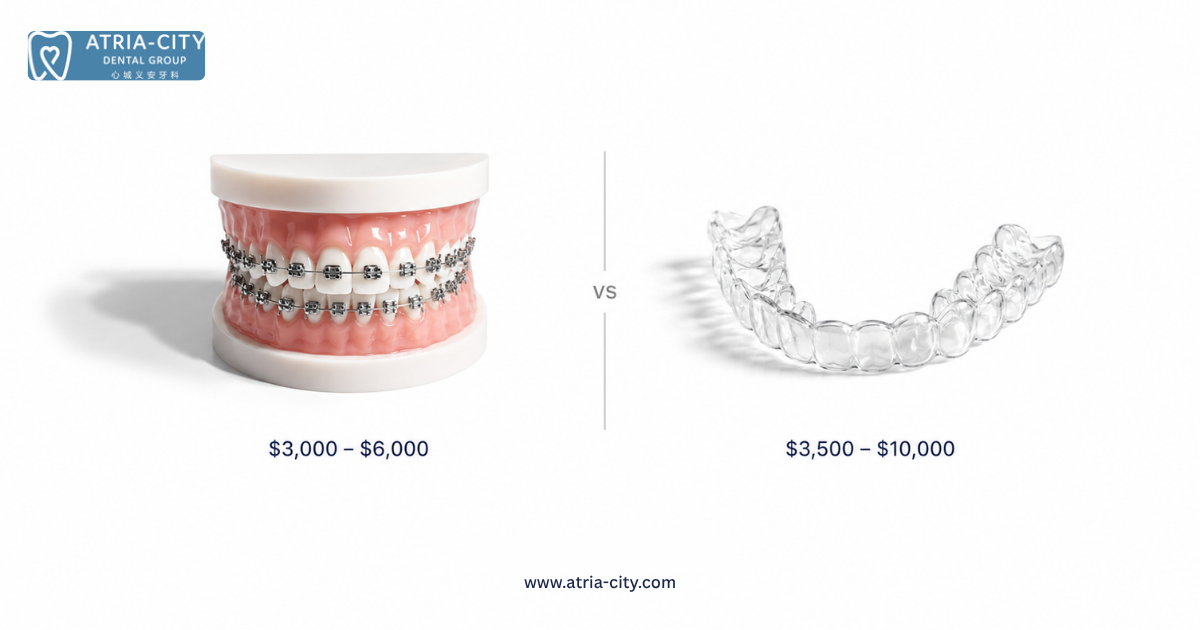
- Metal braces (stainless steel brackets): SGD $3,000 – $6,000
- Ceramic braces (tooth-coloured) – also called Clear braces: SGD $4,000 – $7,000
- Clear aligners (mild to moderate corrections, e.g. Invisalign Lite): SGD $3,500 – $5,000
- Invisalign Comprehensive (complex full-mouth cases): SGD $6,000 – $10,000
These figures cover full treatment from consultation through to orthodontic retainers at completion. Retainers themselves typically add SGD $200 – $600 per arch and are non-negotiable – without them, teeth drift back toward their original position.
The cost difference exists because Invisalign involves laboratory manufacturing of all your aligner trays, digital ClinCheck treatment planning software, and Align Technology licensing fees passed on to patients through the clinic fee.
Who Is Each Option Better For?
Invisalign and clear aligners work well for:
- Mild to moderateteeth alignment corrections – spacing, mild crowding, minor rotation
- Adults and teenagers who can reliably wear aligners 20–22 hours daily
- Patients in professional environments who want an invisible appliance
- Cases where the patient plays contact sports or wind instruments
- Patients who prioritise easier oral hygiene during treatment
Fixed braces are generally recommended for:
- Severe crowding requiring tooth extraction for space creation
- Significant bite corrections (overbite, underbite, crossbite, open bite)
- Younger teenagers whose compliance with removable appliances is unpredictable
- Cases involving tooth rotations greater than 20 degrees
- Patients where cost is a primary constraint
Ourteam for Teeth Straightening in Orchard Singapore includes specialist orthodontists who will assess your specific malocclusion and give you a frank recommendation – not a sales pitch for whichever option generates higher revenue.
The Compliance Factor – Why It Decides Invisalign Outcomes
Invisalign aligners must be worn for 20 to 22 hours per day. You remove them to eat, drink anything other than water, and clean your teeth – then put them back in immediately.
Patients who wear aligners consistently get excellent results that match or approach what braces would achieve. Patients who remove them during meals that run long, at social events, or simply because they forget – see their treatment extend significantly, or encounter teeth that partially rebound between tray changes.
Braces offer predictability as they work 24 hours a day because removal isn’t an option. If genuine compliance is a concern – particularly for teenagers who want clear aligners but are not reliably self-disciplined – the outcome from braces will usually be more predictable.
Teeth Extractions and Orthodontics – A Common Question
Some cases require tooth extraction before orthodontic treatment to create the space needed to align crowded teeth properly. This applies to both braces and clear aligner cases. Extraction-based treatment is not a drawback of one system over the other – it’s a clinical decision based on your jaw size and degree of crowding. Your orthodontist will explain whether extractions are required and why.
Treatment Time: Realistic Expectations
- Minor corrections with either system: 6 – 12 months
- Moderate crowding or spacing: 12 – 18 months
- Complex bite corrections with braces: 18 – 30 months
- Complex cases with clear aligners: 20 – 36 months
Case complexity drives treatment time, not primarily the system used. For similar cases, the time difference between Invisalign and braces is usually within 2 to 4 months. If you have a specific deadline – a wedding, a major event – tell your orthodontist upfront. Treatment can sometimes be sequenced to achieve visible cosmetic improvements first.
FAQs
1. Is orthodontic treatment covered by Medisave or insurance?
Standard orthodontic treatment is not Medisave-claimable as it’s classified as elective. Some corporate dental plans offer a one-time orthodontic benefit – check your policy. See our guide on dental insurance coverage for details.
2. Can adults get braces or Invisalign in Singapore?
Absolutely – adult orthodontics is increasingly common, and there is no upper age limit provided the teeth and supporting bone are healthy. Many adults prefer clear aligners specifically because they’re less visible at work. Book a consultation with adental specialist Singapore to assess your case.
3. Do I need to wear retainers forever?
Yes – indefinitely, though not full-time. After the active treatment phase, Orthodontic retainers are worn nightly to maintain the achieved alignment. Teeth have a lifelong tendency to drift back toward their original position. Retainers prevent this. Skipping retention is the most common reason teeth relapse after orthodontic treatment.
📞 Not sure whether Invisalign or braces is the right choice for your specific teeth? Book an orthodontic assessment at Atria-City Dental, Orchard Road. Honest clinical advice – not a sales pitch. Call 6737 2777 or WhatsApp 8822 8590.
Leave a Reply